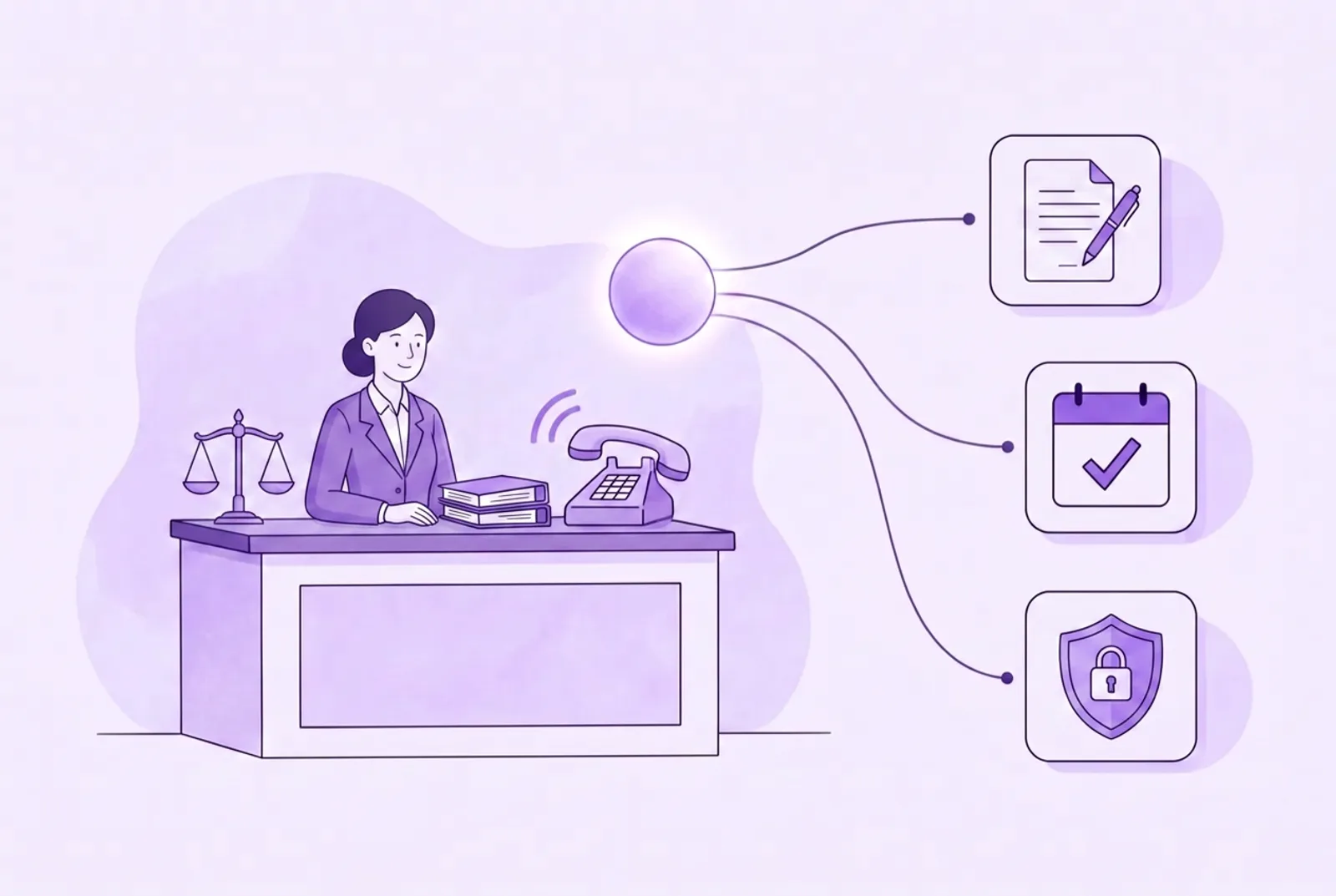

An AI receptionist for a law firm answers every call in a natural voice, runs structured client intake, books consultations into the firm’s calendar, and routes urgent matters to a human, around the clock. Done right, it fixes the specific problem the data says law firms have: most cannot reliably answer their own phones.
One disclosure before the evidence. I am the founder of Credminds, and we build custom voice and chat agents. Our production agents run in transport and consumer services today, not in a law office, so what follows is an engineer’s analysis of the legal intake problem, informed by bar guidance and by what we know breaks in production voice systems, not a war story. If you want the general version of this topic first, our AI receptionist guide for small businesses covers how the technology works; this article is about what changes when the caller is a prospective legal client.
How many calls do law firms actually miss?
The best data on this comes from Clio’s Legal Trends Report, which twice sent mystery shoppers to contact about a thousand US law firms as prospective clients.
In the 2019 study, a person answered 56 percent of phone calls, 39 percent went to voicemail, and more than half of firms never responded to a voicemail within 72 hours. Only 40 percent of firms answered an email inquiry at all.
Five years later, the 2024 edition repeated the exercise, and every number got worse. A person answered only 40 percent of calls. Email responses fell to 33 percent. Fewer than one in five responding firms gave the caller a clear next step.
Meanwhile the callers’ expectations run in the opposite direction: in Clio’s companion survey of 2,000 consumers, 82 percent said timeliness was crucial and 79 percent expected a response within 24 hours. A prospective client in a crisis does not wait three days for a voicemail return. They call the next firm in the search results.
Here is my opinionated read of those numbers: unanswered phones are no longer a staffing problem, they are a decision problem. The technology to answer every call has existed for two years and, per the same 2024 report, 79 percent of legal professionals already use AI in some capacity, up from 19 percent in 2023. The firms still missing 60 percent of their calls have not run out of options. They have not chosen one.
What the search data shows: the switch is happening now
We track US search demand for reception and answering terms in our Small Business AI Demand Index, and the legal vertical is running the same substitution we documented across the wider market, only faster. From our July 2026 pull of US search demand data:
- “ai for law firms”: about 1,300 US searches a month, up 85 percent year over year, with June 2026 the highest month we have on record for the term.
- “ai receptionist for law firms”: up about 40 percent year over year.
- “ai intake for law firms”: did not exist as a tracked term before October 2025.
- “virtual receptionist for law firms”: down 67 percent year over year.
- “law firm answering service”: down 56 percent year over year.
Demand for the traditional service categories is not shifting to AI; it is being replaced by it. Law firms are searching for the AI version of reception in growing numbers while searches for the human-staffed categories fall by half or more. If you are evaluating this now, you are not early. You are in the middle of the curve.
What an AI receptionist does inside a law firm
A general receptionist answers questions and books appointments. A legal one is an intake specialist with a narrow, well-defined job:
Qualify the matter. What kind of problem is this, criminal, family, immigration, injury, business? Is there a deadline, a court date, a statute clock running? Which state or county? A firm that only takes employment cases in one state should learn within a minute that the caller has a landlord dispute two states away, thank them, and point them to a referral resource, politely and without burning attorney time.
Collect what the conflict check needs. The names of the caller and the adverse parties, captured accurately and passed to your team. The check itself stays human. Software can compare names against your matter list and raise a flag; a lawyer decides what the flag means.
Book the consultation. Directly into the firm’s calendar, respecting which attorney handles which practice area, consultation lengths, and buffer rules. Booking is the most mature capability in this category, and it is the step that converts a phone call into revenue. Clio’s own data points the same direction: firms using online intake tools see 50 percent more incoming potential clients on average.
Triage urgency. Someone calling from a police station at 3am is not a booking, it is an escalation. The agent needs an explicit map of what gets a human immediately, what gets booked, and what gets a structured message for the morning.
Handle the after-hours and overflow load. Nights, weekends, lunch, and the surge after a news mention. This is where the always-on property stops being a novelty and starts being the entire point.
The three legal-specific risks, and what the bar rules actually say
Confidentiality. The intake call is full of protected information, and this is not a matter of taste. ABA Model Rule 1.18 states that “even when no client-lawyer relationship ensues, a lawyer who has learned information from a prospective client shall not use or reveal that information” except in narrow circumstances. The person who calls and never hires you is still owed confidentiality, so whatever answers your phone is inside that duty’s perimeter from the first sentence.
The bar has also addressed AI directly. ABA Formal Opinion 512, issued July 29, 2024, warns that because many self-learning generative AI tools could lead to disclosure of client information, “a client’s informed consent is required prior to inputting information relating to the representation into such a GAI tool,” and that boilerplate consent language in engagement letters is not sufficient. The State Bar of California’s practical guidance, revised in 2026, puts it just as plainly: “a lawyer must not input any confidential information of the client into a generative AI solution that may present material risks to confidentiality or security, absent informed client consent.” Texas Ethics Opinion 705 adds that lawyers must actually understand the technology they are using and verify what it produces.
In practice this means a firm needs written answers before going live: where recordings and transcripts are stored, how long they are retained, whether call content trains models, and who at the vendor can read it. It is also the strongest argument for the custom route: an agent deployed on infrastructure the firm controls keeps every recording, transcript, and intake summary inside the firm’s own perimeter.
Unauthorized practice of law. Callers will ask the receptionist whether they have a case, what their options are, and what they should do next. Every one of those questions must hit the same wall: that is exactly what the consultation is for, let me get you booked. A production agent enforces this with hard constraints, not vibes: the system is scoped to intake, scheduling, and logistics, and evaluated against a test set of advice-seeking questions before launch. When you evaluate any vendor, ask to see how it responds to “do I have a case?” If it improvises an answer, walk away.
Conflicts. The failure mode is subtle: an agent that chats warmly with the opposing party of an existing client and books them a consultation has created a professional headache no software vendor will help you clean up. The mitigation is procedural: collect adverse party names on every intake, flag matches for staff review before the consultation happens, and keep a human between the flag and the calendar.
The legal shortlist: what the vendors document
If you go the subscription route, four products come up repeatedly for law firms. This is what each one’s own site documents as of August 2026; we have not run production deployments of these products, so treat this as a map of claims to verify in your trial, not an endorsement.
- Smith.ai pairs AI receptionists with several hundred live North American agents in one system and leans heavily legal: lead screening by practice area, custom intake questions, and documented integrations with Clio, Filevine, Lawmatics, MyCase, and PracticePanther.
- CaseGen positions itself as built specifically for law firms: structured intake interviews, live transfer of high-value cases, follow-up agents, call transcripts and analytics, with Clio, Filevine, and Lawmatics integrations documented.
- Rosie is a general small-business AI answering product with a law firm page: message taking, consultation scheduling, urgent-case prioritization, and an explicit statement that it cannot provide legal advice.
- Upfirst is likewise general-purpose with law firm case studies, focused on screening calls and speeding up intake.
Two gaps stood out in that review. First, none of the four documents conflict-of-interest screening as a feature, which means the Rule 1.18 exposure described above is handled by your process, not their product, on every one of them. Second, none prominently documents how and whether the AI discloses itself to callers. Both are exactly the kind of question to put in writing during a trial.
Evaluating one of these for your firm? Send us a normal week of your phone traffic and we will tell you honestly which route fits, including when the answer is "just subscribe."
Get a free workflow auditRent one or build one
The honest answer, same as in our comparison of the subscription receptionist services: most solo practices and small firms should start with a subscription. The legal answering category is mature, the products handle answer, qualify, book, and message reliably, and you can be live in days. If your intake is a handful of standard questions and a calendar, rent.
A custom agent earns its keep when one or more of these is true:
- Your intake has real logic. Different question flows per practice area, screening rules you have refined over years, referral routing for the matters you decline. Subscription scripts flatten this; a custom agent encodes it.
- It must live inside your systems. Reading attorney availability from your calendar rules, writing matters into your case management system, attaching transcripts, checking names against existing matters. Integration lists end where your actual stack begins.
- Data control is non-negotiable. Given the bar guidance above, keeping recordings and transcripts on firm-controlled infrastructure is a cleaner confidentiality story than any vendor agreement.
- Your callers are not monolingual. An agent that runs the same intake in English, Spanish, Urdu, or Arabic, with the same rules, is a build-side advantage that subscription products handle unevenly.
- The phone is not the only door. The same agent logic can run intake over WhatsApp and SMS. Our Citylink build takes structured bookings over WhatsApp all day in production; the pattern transfers directly to legal intake, where a text-first prospective client is increasingly common.
A reasonable path many firms take: subscribe now, measure for a quarter how many intakes the phone produces and where the script frustrates callers, then decide whether the volume justifies an agent of your own.
When a law firm does not need this
Three situations where I would tell a firm to keep its money:
Your phone is already answered. A staffed front desk during business hours plus low after-hours volume means the AI is solving a problem you do not have. Check your phone system’s missed-call report before believing anyone’s pitch, including ours.
Your clients do not cold-call. Firms serving institutional clients, corporate counsel work, long-standing referral relationships: intake there is relationship-driven and scheduled. An AI receptionist optimizes a funnel you are not running.
Every call genuinely needs attorney judgment. Some boutique practices screen so selectively that intake is effectively the attorney’s first work product. Automating the greeting while the attorney still evaluates every caller saves minutes, not matters.
For everyone else, the arithmetic is straightforward: count the calls that ring out in a month, apply your consultation conversion rate, and remember that Clio’s shoppers found a person answering only 40 percent of the time across a thousand firms. The bar for beating the market is answering your own phone.
Where to start
Pick two or three services and test them against the questions in this article: “do I have a case?”, the confidentiality questions in writing, conflict handling, and a booking that crosses your real calendar rules. If the scripts fit your intake, subscribe and move on. If they do not, that gap is the specification for a custom build.
We audit workflows like this for free: thirty minutes, you walk us through how a call moves from ring to signed engagement letter today, and we map what software can take over, what it would involve, and what should stay human. If a subscription service is the right answer for your firm, that is what we will tell you, and you keep the map either way.