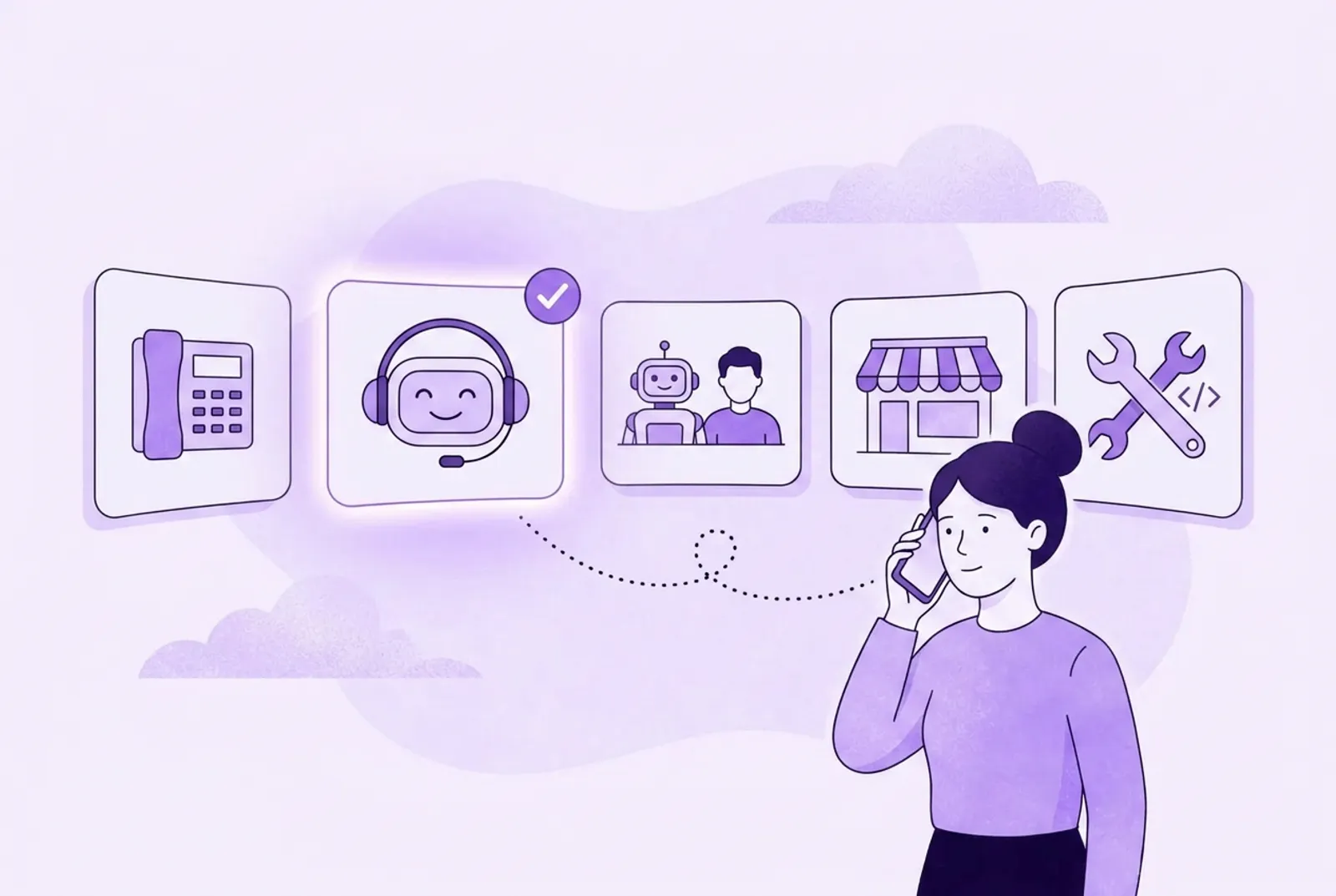

The best AI receptionist for a small business is not one product. It is whichever of five categories matches your calls: an AI receptionist bundled with your phone system, a standalone subscription, an AI-plus-human hybrid, an industry specialist, or a custom-built voice agent. Pick the category first; the product choice inside it is the easy part.
Now the disclosure that should open every article like this one. I am the founder of Credminds. We build custom voice agents, which means we sell exactly one of the five categories below, and for most small businesses it is not the right one to start with. Nearly every other “best AI receptionist” list is published by one of the products in it, and by remarkable coincidence each publisher ranks itself first. This list at least tells you who wrote it.
One more honesty note: we have not run a pretend bake-off. What follows comes from the products’ own documentation, what owners report publicly in small business forums, and what we know about voice AI from building these systems. At the end you get something more useful than a ranking: a 20-minute test that tells you the truth about any of them.
Product details below were verified against vendor documentation in July 2026, and we re-check them quarterly. These products ship changes constantly; if something here no longer matches a vendor’s site, trust the vendor’s site and run the bake-off at the end of this post before deciding anything.
If you are still deciding whether your business needs an AI receptionist at all, start with our full guide to AI receptionists for small businesses; this post assumes you are past that and comparing options.
Pick your category first
| Category | Best when | Examples | Watch for |
|---|---|---|---|
| Bundled with your phone system | You already run the platform | RingCentral, Allo, Nextiva | Locked to that ecosystem |
| Standalone AI receptionist | Standard answer-and-book calls | Rosie, Upfirst, Aira, Dialzara, Goodcall | Features gated by tier |
| AI + human hybrid | High-stakes or sensitive calls | Smith.ai, Abby Connect, Ruby | Slower onboarding |
| Industry specialist | Your industry’s workflow is the hard part | Marlie, Slang, Loman, Greetmate, Ringly, Numa | Poor fit outside the niche |
| Custom-built voice agent | Calls touch your live systems | Built by teams like ours | Overkill for simple needs |
Bundled: the AI already inside your phone system
If your business lines already run through RingCentral, its AI Receptionist add-on answers and routes calls inside the system you use daily. Allo goes further and positions itself as a full phone system replacement with the AI receptionist built in, plus mobile apps and CRM integrations. Nextiva plays the same card in its ecosystem.
This category wins on friction: nothing new to buy, one dashboard, no number porting. It loses on flexibility, because you are choosing the vendor’s AI, mature or not, and leaving means changing phone systems. Turn it on if you are already inside one of these platforms; do not switch phone systems just to get one.
Standalone: the subscription receptionists
This is the crowded middle of the market and where most small businesses should look first.
- Rosie trains itself from your website and Google Business Profile, which makes setup genuinely fast, and offers unlimited minutes with message taking across plans. Two things buyers report: you bring your own phone line, and appointment booking and call transfers sit above the base tier.
- Upfirst emphasizes quick setup, spam call filtering, caller memory across repeat contacts, and support for over 35 languages. Its own comparison page concedes it lacks the deep vertical integrations of specialist tools.
- Aira includes English-Spanish bilingual handling on all plans with automatic language detection, and live transfers that hand your team a context summary. If your callers switch between languages, this is the differentiator that matters.
- Goodcall offers the strongest workflow builder in the group and HIPAA compliance, with tradeoffs elsewhere: limited voice options and no SMS.
- Dialzara is the lightest option of the set, with integrations and call transfers arriving only on upper tiers.
The honest read on this category: these products are good, converging fast, and mostly differentiated by fine print rather than headline features. Which is why the fine print section below matters more than this one.
Not sure which category your calls fall into? Tell us what a normal week of phone traffic looks like and we will tell you honestly, including when the answer is "just use a subscription."
Get a free workflow auditHybrid: AI with humans behind it
Smith.ai runs AI on the front line with several hundred live North America-based receptionists behind it; when a conversation exceeds the AI, a human takes over with context. Its integrations lean legal (Clio, MyCase, Filevine), which tells you its heartland: law firms and professional services where a mishandled call destroys trust. Abby Connect takes a similar human-forward approach for professional services, and Ruby remains the fully human benchmark.
The tradeoff buyers report most is onboarding: hybrids are configured around your intake process by people, which takes real calendar time compared to the paste-your-website setup of the standalone products. Choose this category when a botched sensitive call hurts more than a slow setup.
Specialists: built for your industry
- Marlie targets trades and field service: it captures job locations by text, calculates distances, and integrates with ServiceTitan, Housecall Pro, and Towbook. If you dispatch crews, this is the workflow the generalists cannot model.
- Slang and Loman are restaurant products, wired into reservations and POS systems (Toast, Square, OpenTable), taking orders and bookings while the phone would otherwise ring through a dinner rush.
- Greetmate and Emitrr serve healthcare with HIPAA-ready workflows and EHR integrations, and by their own positioning fit other industries poorly.
- Ringly exists for Shopify stores: order lookups, returns, and cart recovery over the phone.
- Numa focuses on rescuing missed calls with SMS follow-up, popular with auto dealers and service shops.
The rule for this category is simple: if a specialist exists for your industry, it is usually the right shortlist, because the hard part of your calls is exactly what it was built around. Some industries change the evaluation itself, not just the shortlist: for law firms, confidentiality duties and intake rules reshape the whole decision, and for dental practices HIPAA business associate rules do the same, which is why we cover those cases separately in our guides to AI receptionists for law firms and AI dental receptionists.
Custom-built: the category we sell
Full disclosure again: this is us, so read accordingly. A custom voice agent is built on the same speech technology as everything above, but designed around your business: it reads your order database mid-call, applies your real booking rules, answers on WhatsApp and web chat with the same brain that answers the phone, and the code and call data belong to you.
For Citylink, a premium transportation platform, we built the booking agent into WhatsApp because that is where their customers already were; it takes ride requests, applies dispatch logic, and confirms in the same thread, over 50 customer conversations a day with a human able to step in at any point. No subscription receptionist could have done any of that.
When is custom right? When calls require live data (“where is my order?”), when booking rules are genuinely complex, when your customers live on channels the subscriptions do not cover, or when transcripts and recordings must stay on systems you control. The rent-or-build section of our receptionist guide covers this decision in depth, and our AI agent development page shows how we build them. When your needs are standard, do not buy this category; rent a subscription and revisit in a year.
The fine print the vendor lists bury
Read any trial agreement against this checklist before connecting your number:
- Where do call transfers live? On several popular products, transferring a caller to a human is a higher-tier feature. A receptionist that cannot hand off is a voicemail with confidence.
- Does it include a phone line? Some products expect you to bring your own line and forward to them. Not a dealbreaker, but a surprise if you expected a turnkey number.
- Which languages, really? Claims range from English-only to 50+ languages. If Spanish matters to your callers, verify it is included in your tier and actually conversational, not translated menus.
- What does your team see after each call? Transcript, structured message, booking, CRM entry, or a dashboard nobody will open? The after-call artifact is the product you are actually buying.
- Who owns the recordings and transcripts, and what happens to them if you cancel? Ask directly; the answer tells you who owns your customer relationships.
- How long is onboarding, honestly? Paste-your-website products are live in days. Hybrids and healthcare specialists are configured by humans and take weeks. Neither is wrong; mismatched expectations are.
The 20-minute bake-off
Shortlist two products from your category, start both trials, and call them yourself:
- Interrupt it mid-sentence. Modern voice AI recovers; last-generation products plow on. This one test dates the technology instantly.
- Say “let me talk to a person,” once. If anything other than an immediate handoff happens, walk away.
- Ask something it cannot know. A good receptionist admits it and takes a message. A bad one guesses, and now a machine is improvising your policies.
- Run your three most common real calls, the ones your team answers daily, phrased the way real customers phrase them.
- Check the aftermath. Open the dashboard and look at what each call produced. This artifact, not the voice, is what you will live with.
Twenty minutes, no vendor deck, and you will know more than any list can tell you, including this one.
Final thoughts
The AI receptionist market has matured to the point where the products are mostly good and mostly similar inside each category, so the leverage is in choosing the right category and reading the fine print, not in finding a secret winner. The demand side tells the same story: our AI receptionist statistics show US searches for “ai receptionist” roughly tripling year over year while “virtual receptionist” searches fall. Start with your phone platform’s built-in option if you have one, a standalone like Rosie, Upfirst, or Aira if your calls are standard, a hybrid if your calls are sensitive, and a specialist if one exists for your industry.
And if your calls keep colliding with your actual systems, the order database, the booking rules, the WhatsApp thread, that is the signal you have outgrown the subscription category. Tell us what your calls look like and you will get a straight answer about which category you belong in, including, most of the time, one we do not sell.