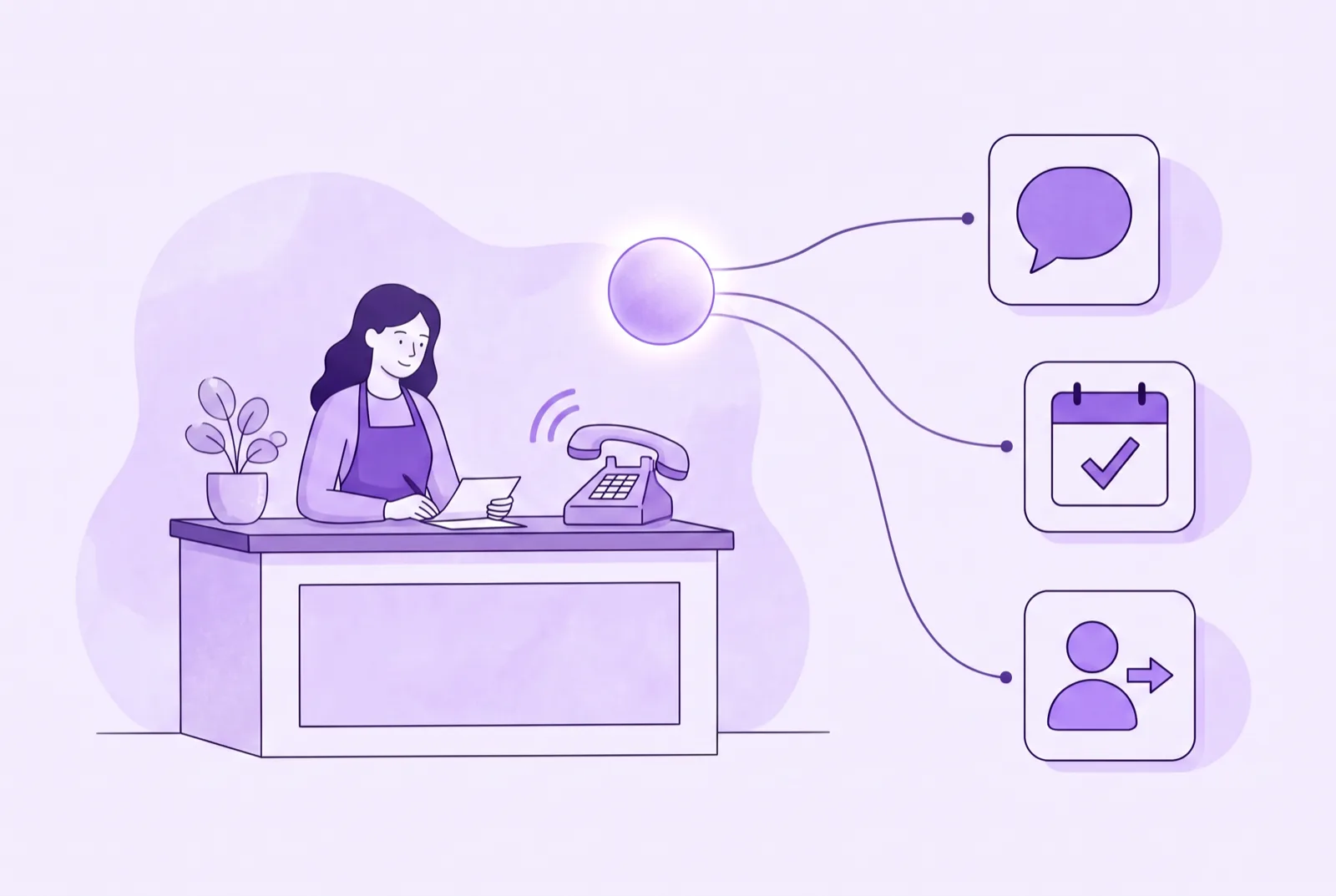

An AI receptionist is software that answers your business phone with a natural voice, around the clock. It tells callers your hours, answers the questions your team repeats twenty times a day, books appointments into your calendar, takes structured messages, and passes urgent calls to a real person. The pitch is simple: every missed call is a customer who dials the next business on the list, and a machine never steps away for lunch.
I am the founder of Credminds. We build custom voice and chat agents for businesses, which means I compete with the subscription receptionist products you have probably been comparing. So let me say the inconvenient part first: for a lot of small businesses, a subscription is the right choice, and the honest version of this article has to explain when that is true, not just when it is not.
If you are past the research stage and want a straight answer on your own setup, the free workflow audit covers exactly this kind of question. For everyone else, here is the full picture.
What an AI receptionist actually does
Strip the marketing and the job has four parts:
Answering. The AI picks up in one or two rings, greets the caller by your business name, and holds a real conversation. Modern voice models handle interruptions, accents, and rambling questions far better than the phone trees you remember, and if you have not heard one recently, they no longer sound robotic.
Resolving. Hours, location, services, whether you handle X, what to bring, how parking works. In most small businesses a handful of questions make up the majority of call volume, and this is where an AI receptionist earns its keep fastest.
Booking. The AI checks availability and books the appointment while the caller is still on the line. This is the most mature capability in the category and the one with the clearest payoff, because an unbooked caller rarely calls back.
Escalating. The part that separates good from bad. When a call is unusual, sensitive, or angry, the AI should recognize it and hand off to a person, or take a structured message after hours. My rule when we build these: judge a receptionist by its escalations, not its answers. An AI that gracefully says “let me get someone for you” builds trust. One that improvises through a complaint destroys it.
Will customers hate it? The question everyone actually has
Search any small business forum about AI receptionists and the recurring worry is not capability, it is acceptance: “will my customers hang up?” Having shipped voice and chat agents into production, here is what actually determines it.
Callers do not object to talking to an AI. They object to three specific failures:
- Latency. If the AI takes two seconds to respond after each thing they say, the conversation feels broken and they hang up. This is an engineering property, not a fixed fact of AI, and it is the first thing to test on any product demo: interrupt it, talk fast, and see how it keeps up.
- The trap. If a caller says “let me talk to a person” and the AI keeps looping, you have converted a customer into an enemy. The escape hatch must always work, on the first ask.
- The pretense. An AI that pretends to be human gets caught, and the caller feels tricked. A receptionist that opens honestly performs better than one engineered to deceive.
Get those three right and the comparison is not “AI versus a friendly human receptionist.” It is “AI versus the voicemail nobody leaves messages on.” That comparison the AI wins comfortably.
The three ways to get one
Every option on the market falls into one of three buckets, and the right bucket depends on what your calls actually involve.
1. Bundled with your phone system. The large phone platforms, RingCentral and GoTo Connect among them, now ship AI receptionist features inside their business phone products. If you already run your lines through one of these, turning the feature on is the lowest-friction starting point: same vendor, same dashboard, nothing new to buy.
2. Standalone subscription receptionists. Dedicated products, some fully automated, some like Smith.ai blending AI with live human agents who take the calls the AI cannot. Setup is typically a web form: your business details, your FAQ answers, your calendar connection, live within days. This category fits businesses whose call handling is genuinely standard: answer, resolve, book, message.
3. A custom voice agent you own. Built on the same underlying speech technology, but designed around your business instead of around a form. This is what we build at Credminds, so discount my enthusiasm accordingly, and it exists for the situations the first two buckets cannot reach.
| Bundled with phone system | Subscription service | Custom voice agent | |
|---|---|---|---|
| Live in | Hours | Days | Weeks |
| Handles | FAQs, routing, basic booking | FAQs, booking, messages | Whatever your workflow needs |
| Connects to | Its own ecosystem | Standard calendars and CRMs | Your actual systems, including legacy ones |
| Conversations follow | The vendor’s script model | Your answers in their template | Your business rules, end to end |
| Channels | Phone, sometimes SMS | Phone, sometimes chat | Phone, WhatsApp, web chat, SMS together |
| You own it | No | No | Yes, code and data |
| Best for | Simple routing on existing lines | Standard answer-and-book needs | Calls that touch real business logic |
When the subscription is the right call
Be suspicious of any builder who never says this, so here it is plainly. Rent, do not build, when:
- Your call handling is genuinely simple. Hours, directions, FAQs, and a booking. No account lookups, no order status, no judgment calls. A template product does this well, and a custom build would be over-engineering.
- You need it live this week. A custom agent takes weeks to do properly. If missed calls are bleeding you right now, switch on a subscription today. Some of our clients started exactly this way and upgraded later, with real call transcripts as the blueprint for what the custom agent needed to do.
- You are not sure yet. A month on a subscription teaches you what your callers actually ask, where the AI stumbles, and whether your customers accept it. That is low-risk market research on your own phone line.
Ready to compare actual products? We keep an honest, category-by-category comparison of the best AI receptionists for small businesses, written by someone who sells none of the subscriptions in it. And if you want proof this category is not hype, our AI receptionist statistics page tracks six years of US search demand: searches for “ai receptionist” overtook “virtual receptionist” in December 2025 and have led every month since.
When a custom voice agent wins
The subscription products share one structural ceiling: they answer about your business, but they cannot act inside it. The moment a call requires touching your systems, the conversation stalls into “someone will call you back,” which is the exact failure you bought the product to fix. Custom wins when:
- Calls involve live data. “Where is my order?” “Is my part in?” “Can I move my appointment and does that change the crew you send?” Answering these requires reading your order database, your inventory, your scheduling rules. That is agent work, not answering-machine work. It is the same class of system as the AI agents we build for operations.
- Your booking is not simple. Multi-step jobs, staff with different skills, travel time between appointments, deposits and confirmations. Template calendars flatten these rules; a custom agent enforces them.
- The conversation is the business. For Citylink, a transportation platform, we built the booking agent into WhatsApp, where their customers already were. It takes ride requests, applies the dispatch logic, and confirms in the same thread. No hold music, no missed bookings, and the channel itself was the differentiator. A receptionist template could not have done any of it.
- Your data should stay yours. Every call a subscription handles flows through the vendor’s infrastructure. For some businesses that is fine. For others, client confidentiality or plain caution says the transcripts, the recordings, and the customer records belong on systems you control. A custom agent can even run on self-hosted models if the data must never leave your infrastructure. Law firms are the sharpest version of this case, enough that we wrote a separate guide to AI receptionists for law firms covering confidentiality, intake, and conflict screening.
- Voice is one door among several. A custom agent is one brain with many mouths: the same logic answering the phone can answer WhatsApp, web chat, and email. We built Airos around exactly this idea, voice commands driving email and calendar actions across providers. Renting a separate tool per channel means training four robots to give four different answers.
How to evaluate any of them: six questions
Whether you are trialing a subscription or interviewing a consultant like us, the same six questions expose the quality:
- “Let me talk to a person.” Say it mid-call, once. If the AI does not hand off immediately, walk away.
- Interrupt it. Talk over the AI mid-sentence. Modern voice systems recover; outdated ones plow on. This one test tells you the technology generation you are dealing with.
- Ask something it cannot know. A good receptionist admits it, takes a message, and moves on. A bad one guesses. You do not want a machine improvising your policies or your promises.
- Check what your team sees afterwards. Every call should produce something useful: a transcript, a structured message, a booking, a CRM entry. If calls vanish into a dashboard nobody checks, the receptionist is a black box.
- Ask where the recordings and transcripts live, who can access them, and what happens to them if you leave. The answer tells you who really owns your customer relationships.
- Ask what it does at 2 a.m. with an emergency call. The answer should be specific: escalation numbers, urgent-message routing, or an honest “it takes a message.” Vague answers here mean nobody designed for it.
The honest summary
An AI receptionist is one of the rare AI decisions where the case is arithmetic: count your missed calls, think about what each of those callers would have become, and the answer usually makes itself. Start with a subscription if your calls are simple and speed matters. Graduate to a custom voice agent when your calls need to touch real systems, when the conversation carries your business rules, or when the data should stay in your hands.
And whichever route you take, hold it to the standard from the middle of this article: fast responses, an escape hatch that always works, and no pretending. Your callers will accept a robot that respects them. They will not accept a phone that rings out, and that, not the robot, is the status quo you are replacing.
And if the phone is only one of several manual processes eating your week, our guide to AI automation for small business covers the rest: orders, follow-ups, documents, and the reports nobody has time to assemble.
If you are weighing this decision for your own phone line, tell us what your calls look like and you will get a straight answer on which bucket you are in, including “just use a subscription” when that is the truth.